

 Shop Online
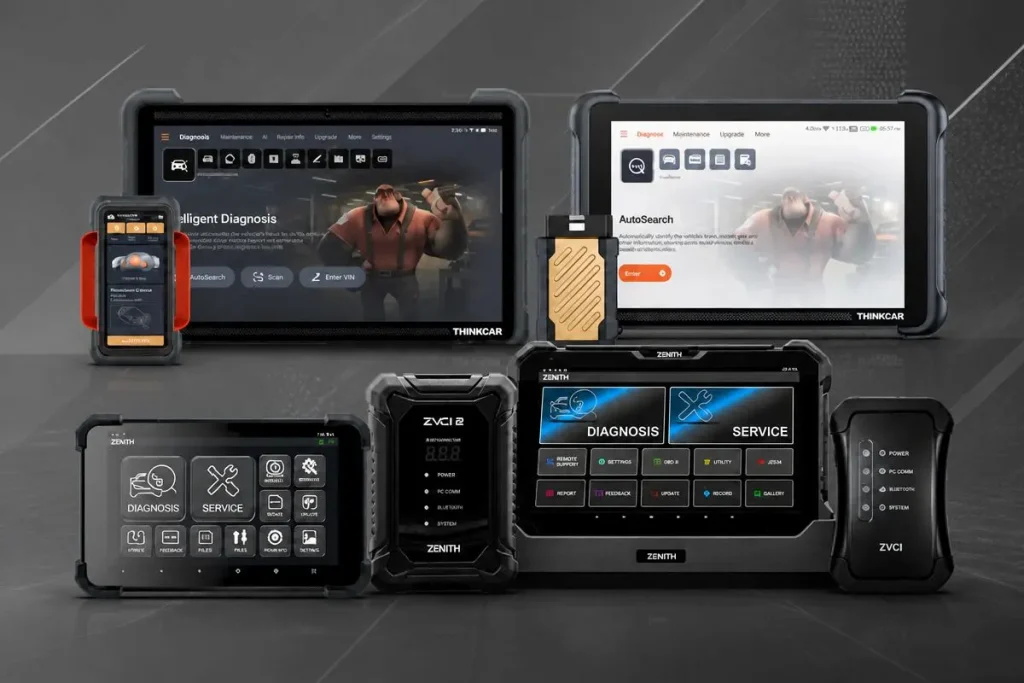
How to Choose the Right Car Diagnostic Scan Tools for Your Repair Shop: 10 Important Factors to Know Before Buying
Modern vehicles feature increasingly complex electronic systems and ECUs, making Automotive Diagnostic Scan Tools essential tools for auto repair shops and technicians. These scanners are useful for checking fault codes (DTCs), analyzing sensor data in real-time, and testing various systems to accurately and quickly identify the root cause of problems.
However, each car scanner model has different capabilities, including vehicle coverage, full system diagnostics , bi-directional control for testing components, as well as special functions for maintenance and ECU configuration.
Therefore , choosing the right car scanner shouldn’t be based solely on price, the number of supported car brands, or the advertised number of functions. Instead, one should evaluate its actual usability, the vehicle’s system coverage, software update costs, and after-sales service to ensure a worthwhile long-term investment.
This article will introduce 10 important factors to consider when choosing a car diagnostic scanner that garage owners and mechanics should consider before making a purchase.
To help you select the right automotive diagnostic tool for the job and to ensure it supports the latest automotive technologies.
| Factor | Things to consider. |
|---|---|
| 1. Vehicle Coverage | Supports various makes, models, years, and types of vehicles for inspection, such as European, Japanese, and Chinese cars, EVs/Hybrids. |
| 2. System Coverage | How many systems can be checked, such as Engine, ABS, SRS, Transmission, BCM (Full System)? |
| 3. Bi-directional Control | Is it possible to order device testing via the ECU (Active Test)? |
| 4. Special / Service Functions | Supports Oil Reset, EPB, BMS, DPF, SRS, Injector Coding, etc. |
| 5. ECU Coding & Programming | To what extent does it support ECU coding, adaptation, calibration, or programming? |
| 6. Communication Protocols | Supports CAN, CAN FD, DoIP, and other necessary protocols for modern vehicles. |
| 7. Security Gateway Access | Does it support access to SGW/SFD systems of certain vehicle brands? And are there any additional costs? |
| 8. Software Updates | Update frequency, free trial period, and software renewal fee. |
| 9. Hardware & Usability | Device speed, screen size, battery life, ease of use, and the Thai language. |
| 10. After-sales Support & Cost | Pricing, warranty, training, technical support, and long-term costs. |
FAQ
This means the scanner can access and inspect multiple electronic control units (ECUs) within the vehicle, not just the engine.
For example,
-
Engine Control System (ECM/PCM)
-
Transmission (TCM) – Automatic Gearbox
-
ABS / ESP – Braking and stability control system.
-
SRS / Airbag – Airbag system
-
BCM – Body Electrical Control System
-
HVAC – Air Conditioning System
-
EPS – Electric Power Steering System
-
BMS – Battery Management System
Generally, it can read and clear diagnostic trouble codes (DTCs), as well as view real-time sensor data (live data).
However, “Full System” doesn’t mean the system supports every system in every car model. You need to check the coverage for each make and model of car.
2. What is Bi-directional Control?
Bi-directional control refers to the ability of a car scanner to send commands to the electronic control unit (ECU) to control or activate various devices within the vehicle for testing and troubleshooting without having to wait for the system to function normally.
This function is often referred to as Active Test, Actuation Test, or Actuator Test , which are terms chosen by different car scanner manufacturers. While the terms are similar in meaning, they emphasize slightly different details, including:
- Bi-directional Control: The ability to send control commands to the ECU and receive feedback.
- Active Test: A proactive testing method that instructs the ECU to perform specified tests.
- Actuation Test: Activating a device, such as turning on the radiator fan or ordering the fuel pump to operate.
- Actuator Test: Testing devices that operate according to ECU commands, such as motors, valves, and solenoids.
How does bi-directional control differ from general monitoring?
A scanner with general diagnostics functionality can send requests to the ECU to read fault codes (DTCs) and sensor operating data (live data), but it does not necessarily need to support device control.
While scanners with bi-directional control can send commands to the ECU to activate various devices for direct testing and verification of responses, under conditions supported by the vehicle.
Examples of using Actuation Test.
| system | Test examples |
|---|---|
| Cooling System | Control the radiator fan to turn on/off. |
| Fuel System | Order a test of the fuel pump. |
| ABS | Order a test of the pump and solenoid valve. |
| HVAC | Order a test of the wind direction adjustment motor. |
| EGR System | Order to open/close the EGR valve. |
| Engine Management | Order a test of the fuel injectors. |
Example: If the radiator fan is not working, a mechanic can use an Actuation Test to instruct the ECU to turn on the fan for testing. If the fan responds as commanded, it can help narrow down the investigation to find the cause more quickly.
In summary: Bi-directional control is a key feature of professional automotive diagnostic scanners because it allows technicians to check more than just reading fault codes, reducing guesswork and improving diagnostic efficiency. The supported function varies depending on the make, model, year of the vehicle and the ECU system.
This function is designed to perform specific operations on automotive systems, such as resetting values after maintenance, calibrating sensors, registering new devices, or instructing the ECU to learn new operating values.
For example, when replacing the battery in some car models, the technician may need to use the Battery Registration function to inform the power management system that the battery has been replaced. This is not just to test whether the battery is working, but to adjust the information within the control system to match the newly installed equipment.
Examples of Special Functions include:
- Oil Reset: Resets the oil change reminder.
- EPB Service: Enters maintenance mode for brake pad replacement.
- Battery Registration / BMS Reset: Register a new battery or reset its related data.
- SAS Calibration: Calibrate the steering wheel angle sensor.
- DPF Regeneration: Initiate the diesel particulate filter regeneration process under specified conditions.
- Throttle Adaptation: Learns or calibrates the throttle valve’s operating values.
- Injector Coding: Records new injector compensation codes into the ECU for compatible vehicles.
In short, Special Functions help technicians correctly perform maintenance procedures and system settings, although some functions may alter or record data within the ECU.
ECU coding is the process of defining or modifying settings within the electronic control unit (ECU) to ensure the system operates in accordance with the installed equipment, vehicle model, or features.
For example, when replacing the Body Control Module (BCM) in some car models, the new module may need to be coded to configure various settings to match the equipment installed in that particular car from the factory.
Examples of ECU coding work.
- Variant Coding: Configures system settings based on the vehicle model and installed equipment.
- Module Replacement Coding: Reset the ECU after replacing a part.
- Feature Configuration: Enable or adjust feature settings allowed by the manufacturer.
- Vehicle Configuration: Configure the system’s operating settings to match the vehicle information.
In short, ECU coding involves changing the operating parameters of the ECU; it’s generally not about rewriting the entire control program.
ECU programming is the process of writing or installing software into the ECU’s memory. This may involve updating existing software (software update) or writing new software (reprogramming/flash programming).
This function is typically used when it’s necessary to fix software bugs, improve system performance, or prepare a new ECU box to meet the vehicle manufacturer’s specifications.
Examples of ECU Programming work.
- ECU Software Update: Update the ECU software according to the manufacturer’s specified version.
- ECU Reprogramming: Writing new software or calibration data into the ECU.
- Module Replacement Programming: Install the appropriate software into the replaced ECU box.
- Firmware Flashing: Write or update the firmware of the control box.
For example, some car models may have transmission problems caused by the control software. The car manufacturer may release a new software version to fix the issue. Therefore, technicians need tools compatible with ECU programming to install such software.
When choosing an automotive diagnostic scanner, the primary consideration should be the type of repair work and the brand of vehicle being serviced. They can be categorized according to their intended use as follows:
- For general inspection and maintenance: Choose a device that supports full system diagnostics, live data, and essential service functions such as oil reset, EPB, and BMS.
- In-depth problem analysis: A bi-directional control (active test/actuation test) should be implemented to test equipment and comprehensively support automotive systems.
- Advanced electronic system repair: Should include ECU coding, adaptation, and ECU programming as needed, as well as support for CAN FD, DoIP protocols, and access to the security gateway of newer vehicle models.
In addition to the machine’s capabilities, other factors to consider include vehicle coverage, software updates, ease of use, after-sales service, and long-term costs.
Most importantly, you shouldn’t choose a scanner based solely on the number of functions or advertised price. Instead, you should check that the scanner supports the make, model, year of your vehicle and the functions you actually need, in order to get a suitable and cost-effective scanner for your investment.
